
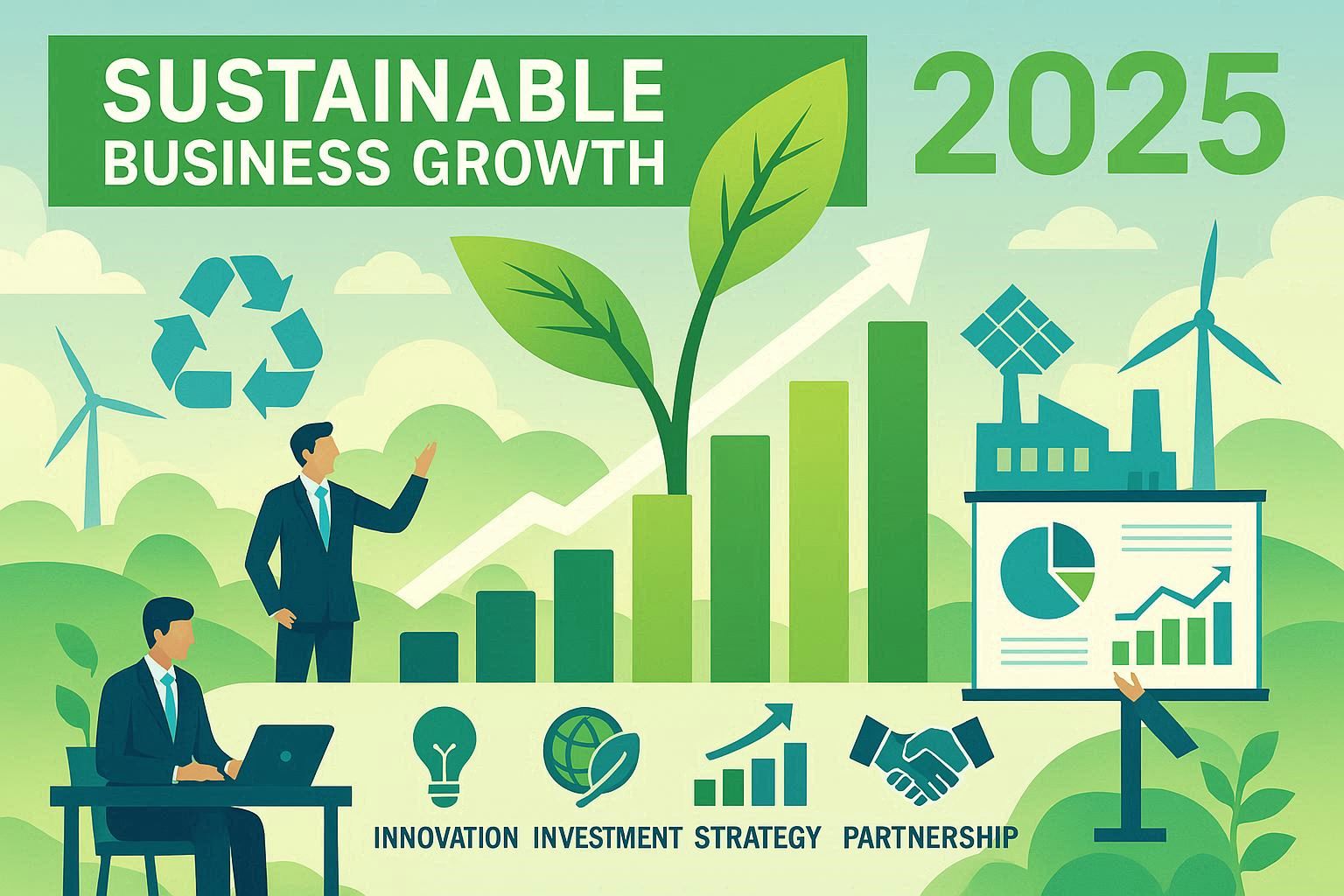
As global markets evolve, the concept of business growth is being redefined. In 2025, success is no longer measured only by profits, but by sustainability, innovation, and adaptability. Businesses that align their goals with environmental responsibility, digital transformation, and customer-centric approaches are emerging as leaders in the modern economy.
This article explores the most effective strategies for achieving sustainable business growth in 2025, focusing on innovation, ethical practices, and long-term competitiveness.
1. Redefining Growth in a Changing World
The business landscape in 2025 is shaped by global challenges such as climate change, digital disruption, and evolving consumer expectations. Companies are recognizing that short-term profit maximization can no longer guarantee longevity. Instead, sustainable growth—built on innovation and responsibility—has become the new priority.
Investors, consumers, and employees now expect organizations to demonstrate transparency, inclusivity, and purpose. Businesses that fail to adapt risk losing relevance in an increasingly values-driven market.
2. The Role of Digital Transformation
Digital transformation continues to be a cornerstone of business growth in 2025. Artificial intelligence, data analytics, and automation empower organizations to improve efficiency, reduce costs, and enhance decision-making. Cloud-based systems and remote collaboration tools also enable flexibility, allowing companies to scale operations globally.
Moreover, digital ecosystems provide real-time insights into consumer behavior, helping businesses personalize experiences and strengthen brand loyalty.
3. Building Sustainable and Ethical Practices
Sustainability is now a competitive advantage. Companies integrating eco-friendly operations—such as renewable energy, circular economy models, and waste reduction—are attracting both investors and conscious consumers. Environmental, Social, and Governance (ESG) metrics have become central to business strategy and performance evaluation.
By embedding sustainability into core operations, organizations can enhance efficiency, build trust, and meet growing regulatory expectations worldwide.
4. Innovation as a Driver of Long-Term Success
Innovation remains the heartbeat of sustainable growth. From developing new products to reimagining customer experiences, businesses that foster creativity and experimentation are thriving. In 2025, innovation is no longer limited to technology—it extends to culture, leadership, and strategy.
Startups and established enterprises alike are embracing open innovation, forming partnerships with research institutions, startups, and even competitors to co-create solutions for shared challenges.
5. The Power of Data-Driven Decision Making
In the modern business ecosystem, data is one of the most valuable assets. Companies that use analytics and machine learning to understand market trends, customer needs, and internal performance gain a clear strategic advantage. Predictive analytics helps leaders anticipate change, reduce risks, and seize new opportunities before competitors.
By integrating advanced data systems, businesses can align growth strategies with real-world insights rather than assumptions.
6. Customer Experience as a Growth Engine
Consumers in 2025 expect more than just quality products—they demand personalized experiences, ethical brands, and seamless digital interactions. Businesses are investing in omnichannel engagement, artificial intelligence chatbots, and human-centered design to enhance satisfaction and retention.
Happy customers not only stay loyal but also become advocates, contributing to organic growth through word-of-mouth and social media influence.
7. Financial Resilience and Smart Investment
Economic uncertainty remains a key challenge for businesses worldwide. To ensure sustainable growth, companies must focus on building financial resilience. Diversified revenue streams, cost optimization, and strategic reinvestment in innovation are vital.
In 2025, many organizations are also leveraging decentralized finance (DeFi) and blockchain technology to streamline operations and improve transparency in global trade.
8. The Human Factor: Empowering Teams
No business can grow sustainably without an empowered workforce. Investing in employee well-being, diversity, and continuous learning leads to higher engagement and innovation. Hybrid work models and flexible schedules have become the norm, promoting productivity and satisfaction.
Leadership in 2025 focuses on empathy, communication, and inclusivity—qualities that foster trust and inspire long-term commitment.
9. Global Expansion and Localization
Globalization continues to create opportunities for businesses seeking new markets. However, successful international expansion requires understanding local cultures, regulations, and consumer behaviors. Companies adopting a “glocal” approach—global vision with local adaptation—achieve sustainable growth across diverse regions.
Localization not only strengthens market penetration but also builds stronger community relationships.
10. The Future of Sustainable Business Growth
Looking ahead, the most successful businesses in 2025 and beyond will be those that balance profitability with purpose. By integrating technology, innovation, and ethical responsibility, organizations can build resilient systems that thrive in uncertainty.
Consumers, governments, and investors are increasingly aligned in supporting companies that contribute positively to society and the planet. The future of business growth lies in creating value not only for shareholders but for all stakeholders.
Conclusion
Sustainable business growth in 2025 is about aligning innovation, responsibility, and long-term vision. Companies that embrace change, invest in people, and commit to ethical progress will shape the future economy. In a world where success depends on adaptability and trust, sustainability is no longer a choice—it’s a necessity.