
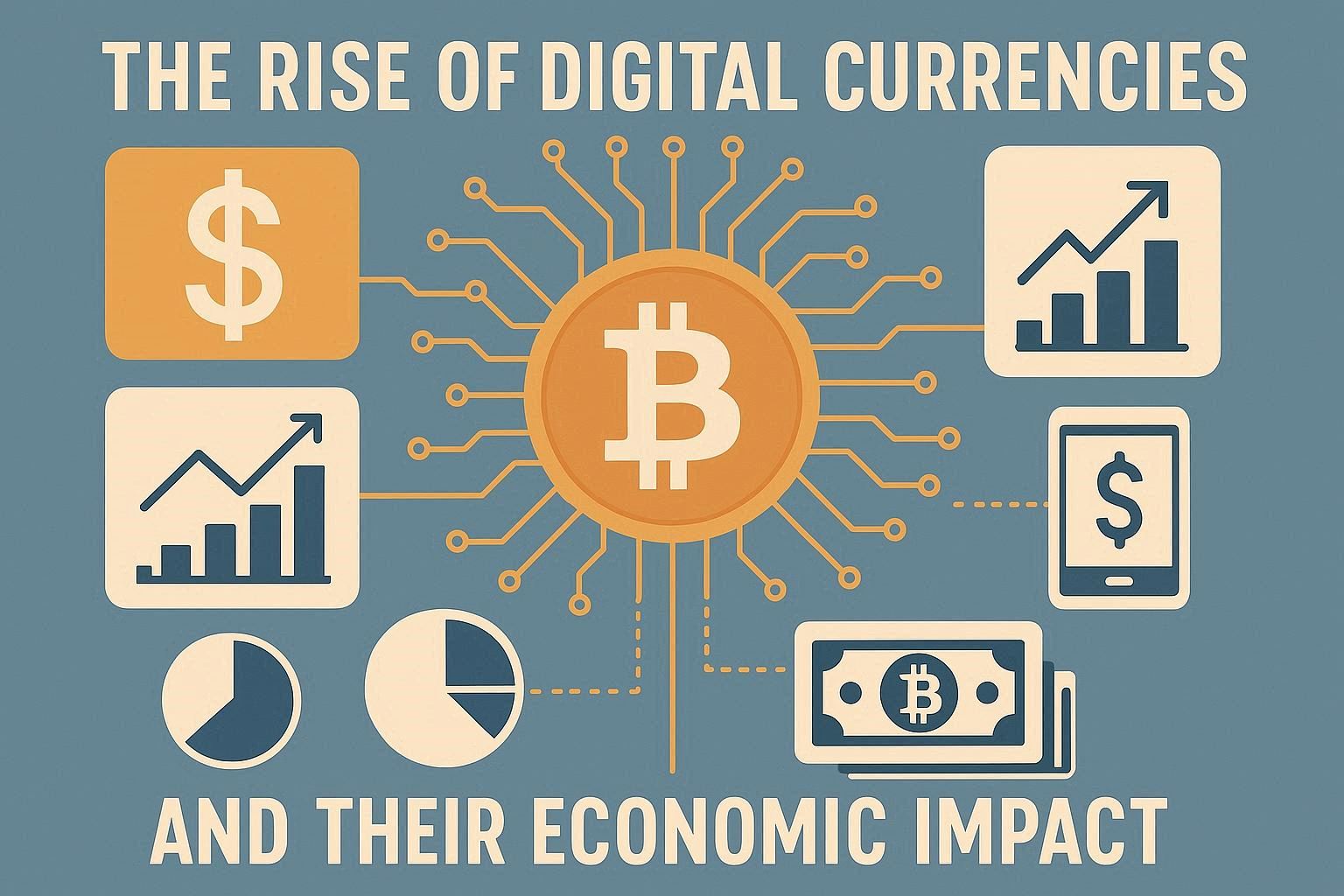
In 2025, digital currencies are no longer just a futuristic concept—they are a defining element of the global financial system. From Bitcoin and Ethereum to Central Bank Digital Currencies (CBDCs), the rise of digital money is reshaping how people pay, invest, and store value. As governments, businesses, and consumers embrace this transformation, the economic impact is being felt across all sectors—from banking to global trade.
This article explores the evolution of digital currencies, their advantages and challenges, and how they are influencing the global economy in profound and lasting ways.
1. Understanding Digital Currencies
Digital currencies are forms of money that exist purely in electronic form. Unlike traditional cash, they are decentralized, secure, and borderless. They rely on blockchain technology—a distributed ledger that ensures transparency, immutability, and efficiency. The two main categories are cryptocurrencies (like Bitcoin and Ethereum) and Central Bank Digital Currencies (CBDCs) issued by national authorities.
2. The Growth of Cryptocurrencies
Since their introduction, cryptocurrencies have evolved from niche assets into mainstream financial instruments. Millions of people use them for payments, savings, and investment. Companies such as Tesla, PayPal, and Visa have integrated crypto transactions into their platforms, signaling institutional confidence. Beyond speculation, blockchain-based systems now power decentralized finance (DeFi), gaming, and supply chain tracking, expanding the role of crypto in the real economy.
3. The Rise of Central Bank Digital Currencies (CBDCs)
In response to the growing influence of private cryptocurrencies, central banks around the world are developing their own digital currencies. Countries like China, the European Union, and the United States are testing or implementing CBDCs to modernize payment systems, improve financial inclusion, and strengthen monetary policy control. Unlike cryptocurrencies, CBDCs are government-backed, offering stability and legal recognition while maintaining digital efficiency.
4. Economic Benefits of Digital Currencies
The shift to digital currencies brings multiple benefits. Transactions become faster and cheaper, especially across borders. Financial inclusion improves as people without traditional bank accounts gain access to digital wallets. Businesses reduce costs related to payment processing, while governments can track and manage economic activity more transparently. These advantages contribute to higher economic efficiency and innovation in the financial sector.
5. Challenges and Risks
Despite their potential, digital currencies also present challenges. Price volatility remains a concern for cryptocurrencies, making them unreliable as a stable medium of exchange. Regulatory uncertainty, cybersecurity threats, and privacy concerns are major obstacles to mainstream adoption. CBDCs raise additional questions about data security, surveillance, and the potential impact on commercial banks’ roles in credit creation and deposits.
6. Impact on Global Trade and Investment
Digital currencies are transforming international trade by reducing dependency on traditional banking intermediaries. Businesses can complete cross-border transactions instantly, reducing transaction costs and increasing liquidity. Investors also gain new opportunities to diversify portfolios through crypto assets and tokenized securities. However, the rapid growth of digital finance requires updated global regulations to prevent fraud, tax evasion, and illicit financial flows.
7. Influence on Monetary Policy
Digital currencies challenge the traditional tools of central banks. As CBDCs become more prevalent, monetary authorities will have greater ability to implement targeted policies such as programmable money and real-time stimulus. However, decentralized cryptocurrencies limit state control, creating tension between innovation and regulation. Balancing these forces will be crucial for maintaining financial stability.
8. The Role of Blockchain Technology
At the core of digital currencies is blockchain technology—a secure, decentralized database that eliminates intermediaries. Its applications extend far beyond finance, including logistics, healthcare, voting, and intellectual property management. As blockchain becomes more energy-efficient and scalable, it will continue to underpin the next wave of digital economic transformation.
9. The Future of Digital Payments
By 2030, digital payments are expected to dominate global commerce. Consumers will shift from physical cards and cash to biometric and crypto-enabled payment systems. Traditional banks will evolve into digital ecosystems offering crypto wallets, AI-powered financial advice, and seamless integration with decentralized finance platforms. This transformation will redefine competition and collaboration across the financial industry.
10. Balancing Innovation and Regulation
The success of digital currencies depends on achieving the right balance between innovation and regulation. Governments must establish clear legal frameworks that encourage technological progress while protecting consumers and ensuring financial integrity. International cooperation is essential to prevent market fragmentation and create interoperability between different digital currency systems.
Conclusion
The rise of digital currencies marks one of the most significant economic revolutions of the 21st century. By enabling faster, cheaper, and more inclusive financial systems, they have the potential to reshape global trade, investment, and monetary policy. Yet, this evolution also brings complex challenges that require collaboration between innovators, regulators, and consumers.
As 2025 unfolds, digital currencies stand at the crossroads of technology and economics—a symbol of both progress and disruption. The nations and businesses that adapt early to this transformation will define the future of global finance and the next era of economic growth.