
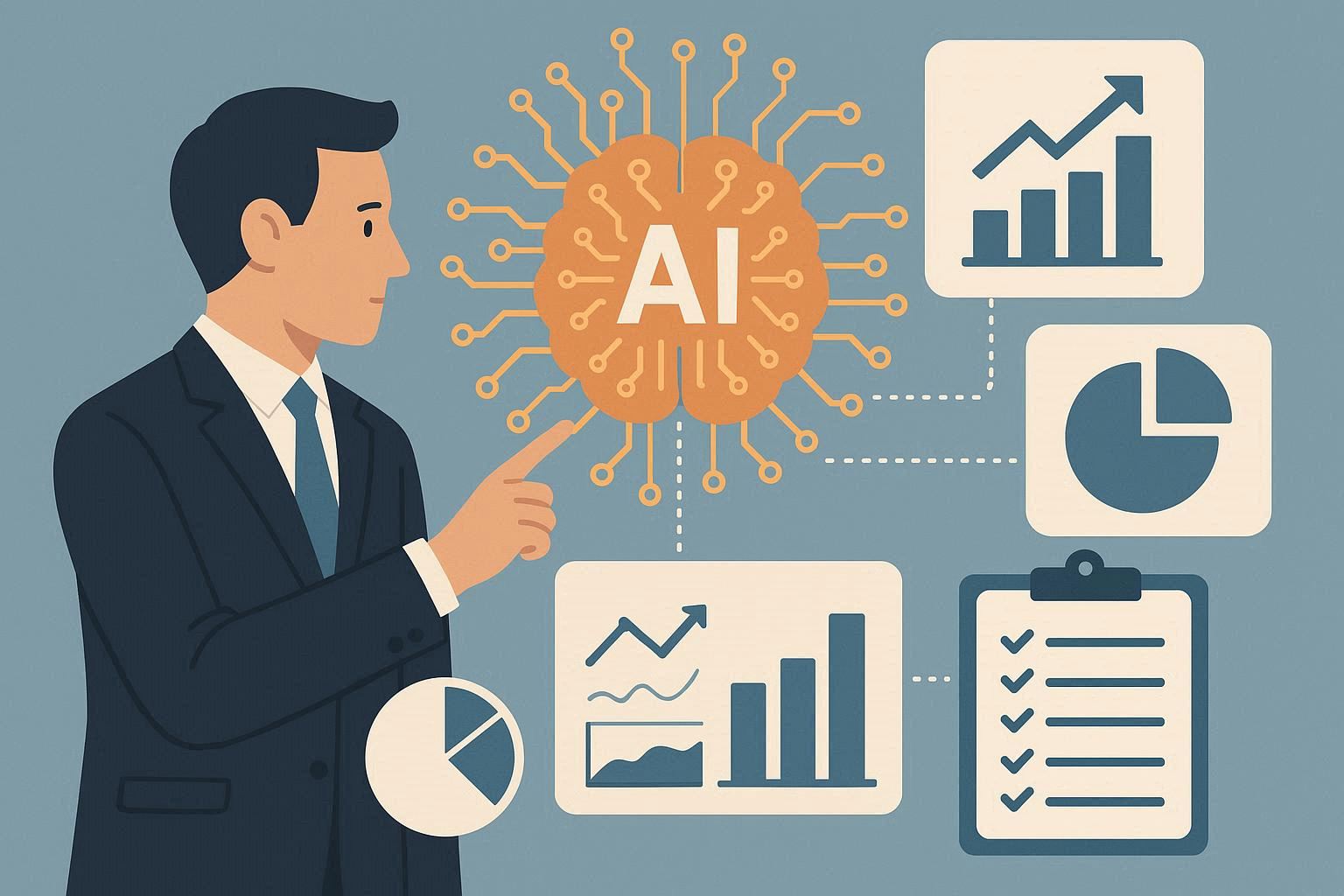
Artificial Intelligence (AI) has become a cornerstone of modern business strategy. In 2025, companies of all sizes are leveraging AI to analyze data, predict trends, and make smarter, faster decisions. From financial forecasting to customer engagement, AI-driven systems are transforming how leaders operate and compete in today’s digital economy.
1. The Growing Importance of AI in Business
Decision-making is at the heart of every business. In the past, leaders relied on experience, instinct, and historical data. Today, AI adds a new layer of intelligence—processing massive datasets in real time, identifying hidden patterns, and offering insights that were previously impossible to detect. This capability allows businesses to make data-driven decisions that minimize risk and maximize performance.
2. How AI Transforms Business Decisions
AI-powered analytics tools help organizations understand their markets, customers, and internal operations better than ever before. Predictive models can forecast sales trends, optimize inventory levels, and even detect fraud before it occurs. Machine learning algorithms continuously learn from new data, improving their accuracy and reliability over time.
3. AI in Strategic Planning
Strategic planning has evolved into a data-centric process. AI assists executives in evaluating different scenarios, testing potential strategies, and forecasting outcomes. By using AI simulations, businesses can anticipate the impact of decisions on revenue, customer satisfaction, and operational efficiency. This enables organizations to adapt quickly to changing market conditions and maintain a competitive edge.
4. Enhancing Customer Understanding
AI tools such as natural language processing and sentiment analysis allow companies to better understand customer needs and preferences. Businesses can analyze customer feedback, online behavior, and purchase histories to create personalized experiences. This level of insight improves marketing efficiency, boosts sales conversions, and strengthens brand loyalty.
5. AI in Financial Decision-Making
In finance, AI plays a crucial role in risk management, investment analysis, and credit scoring. Automated trading systems analyze real-time market data to make investment decisions in milliseconds. Meanwhile, AI models assess loan applicants, predict repayment behavior, and prevent fraudulent transactions. This precision ensures financial stability and better resource allocation.
6. Operational Efficiency and Process Automation
AI-driven automation helps organizations streamline repetitive tasks such as scheduling, data entry, and customer support. Intelligent systems can identify inefficiencies, reduce operational costs, and free up human employees to focus on innovation and strategic growth. This not only enhances productivity but also creates a more agile business environment.
7. Human-AI Collaboration
Contrary to fears of job replacement, AI is increasingly seen as a collaborator rather than a competitor. In 2025, businesses are adopting a “human-in-the-loop” approach, where AI systems provide data insights, and humans make final judgments based on context and ethics. This synergy enhances creativity, reduces bias, and leads to more balanced decision-making.
8. Ethical and Regulatory Considerations
As AI becomes integral to decision-making, ethical challenges emerge. Issues like data privacy, bias in algorithms, and transparency must be addressed. Governments and international organizations are introducing AI governance frameworks to ensure fairness, accountability, and trust in automated decisions. Businesses that prioritize ethical AI gain credibility and long-term success.
9. The Future of AI-Driven Decision-Making
Looking ahead, AI will continue to evolve, becoming even more intuitive and context-aware. The integration of generative AI, edge computing, and quantum algorithms will allow real-time decision-making at an unprecedented scale. Organizations that invest in AI literacy and digital infrastructure will lead the next wave of business innovation and growth.
Conclusion
Artificial Intelligence is not just a technological upgrade—it is a strategic transformation. In 2025, businesses that embrace AI in decision-making gain a decisive competitive advantage, combining speed, accuracy, and adaptability. By aligning AI with human intelligence and ethical responsibility, organizations can unlock a future where smarter decisions drive sustainable success.